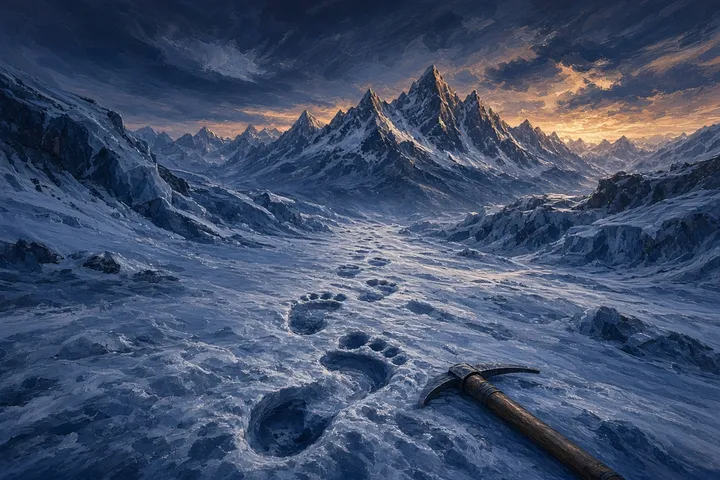

1899: Waddell’s footprints
This is where the age of yeti footprints begins: a British officer sees strange tracks in the snow, and his companions at once name the hairy wild man of the snows.

What happened
Laurence Austine Waddell was a British Army officer and a scholar of Tibetan and Buddhist culture. In his book Among the Himalayas, published in 1899, he described how, while travelling in northeast Sikkim some years earlier, his party came across large footprints in the snow that crossed their path and led up towards the high peaks.
His companions said they belonged to the hairy wild men who live in the most inaccessible mountains. Waddell himself believed the tracks were made by a bear. Of all the witnesses he questioned, he wrote, none could give him an authentic case; it always came down to something heard from others.
Even so, his account is often cited as the first written description of ‘yeti footprints’ seen by a Westerner.
In Aowri
Waddell appears in the yeti history Mukit recalls: in the novel he is ‘Lawrence Wedel’, who claimed in 1899 to have seen the yeti’s footprints.
But in Aowri the real mystery is not footprints but the traces people have left behind. Where those traces lead Mukit is in the book.
“In 1899, an explorer named Lawrence Wedel claimed he had seen the yeti’s footprints.”