
1960: Khumjung’s ‘yeti scalp’
A conical relic covered in reddish-black hair, guarded for generations by the people of Khumjung as the scalp of a yeti. It left the village only once.
What happened
In 1960–61 Edmund Hillary led a large scientific and mountaineering expedition known as the ‘Silver Hut’ expedition. It was funded by World Book Encyclopedia, and one of its aims was to look for evidence of the yeti.
The yeti scalp kept in Khumjung monastery was sacred to the village. After long negotiation it was agreed that a village elder would travel with it as its guardian, and that it would be returned within a set time. Hillary, the journalist Desmond Doig and the village’s representative took it to Chicago, Paris and London.
The experts agreed that it had most likely been made from the hide of a serow, a Himalayan goat-antelope. The scalp was returned to Khumjung and is still kept in the monastery.
In Aowri
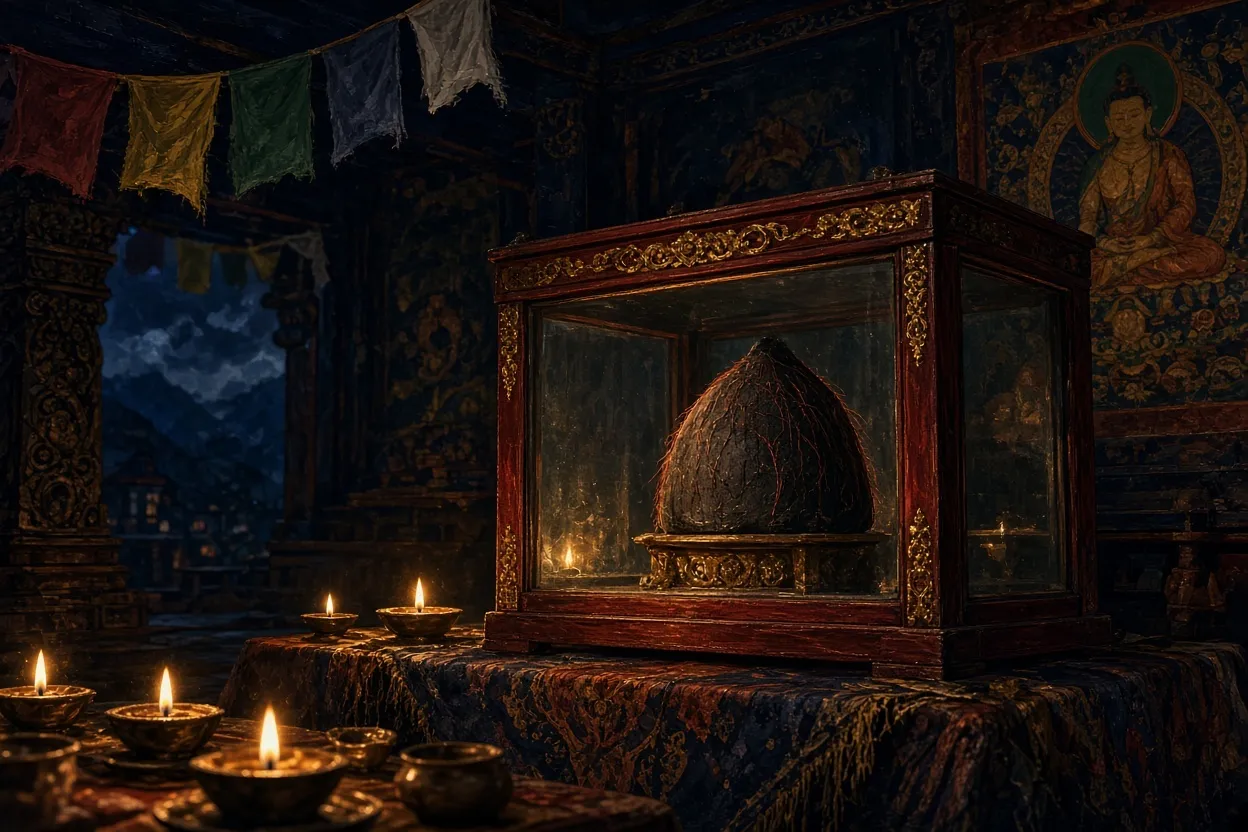
This is the most detailed yeti scene in Aowri. Hearing about it from Dilbahadur, Mukit goes to the Khumjung monastery and sees the head in a glass case framed in red wood: bald in the middle, with red and black hair still clinging to the sides.
The novel also captures the villagers’ fear that losing the relic might bring disaster on the village, and the fact that Hillary’s tests proved nothing.
“It looked exactly like a big black football cut down the middle and set down.”